
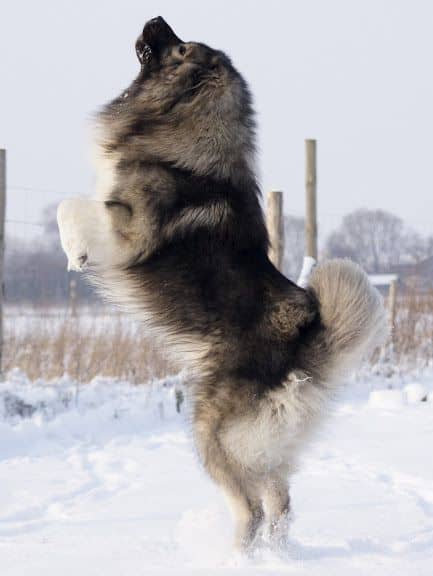
Exercise needs of the Caucasian Shepherd Dog differ significantly from those of athletic or high-drive working breeds. The breed was developed for sustained vigilance and territorial responsibility rather than repetitive physical exertion or speed-based tasks.
Evaluating exercise requirements requires focusing on type and context of activity, not just duration or intensity.
The Caucasian Shepherd Dog requires moderate, purposeful exercise that supports endurance and mental stability rather than high-intensity or repetitive physical activity.
Endurance Over High-Intensity Activity
The breed is built for endurance, not bursts of speed.
Long periods of calm observation punctuated by short responses to environmental changes define its natural activity pattern. Continuous high-intensity exercise does not align with this design and may lead to fatigue without benefit.
Steady movement supports physical condition more effectively than strenuous routines.
Purposeful Movement Versus Play
Exercise is most effective when it has purpose.
Walking defined boundaries, moving through familiar territory, or accompanying routine outdoor activity aligns better with the breed’s instincts than play-driven exercise. Unstructured play may be tolerated but is not central to physical or mental balance.
Purpose reinforces stability.
Mental Workload and Environmental Engagement
Mental exertion is as important as physical movement.
Monitoring surroundings, evaluating stimuli, and maintaining territorial awareness constitute a significant portion of the breed’s daily workload. These activities consume energy even when the dog appears inactive.
Underestimating mental effort can lead to unnecessary overexertion.
Frequency and Consistency
Consistency matters more than volume.
Regular, predictable activity supports equilibrium and reduces restlessness. Irregular bursts of excessive exercise followed by inactivity do not reflect the breed’s natural rhythm.
Routine stabilizes behavior.
Age and Exercise Requirements
Exercise needs change with age.
Younger dogs require controlled exposure and gradual conditioning rather than intense activity. Mature adults benefit from steady movement that maintains muscle tone without stressing joints.
As the dog ages, exercise shifts toward mobility preservation rather than performance.
Environmental Influence on Exercise
Environment determines how exercise is expressed.
Open spaces allow the dog to move and observe simultaneously, which aligns with its guarding role. Confined environments may require more structured movement to compensate for reduced territorial engagement.
Environmental fit often determines perceived exercise needs.
Misinterpretation of Low Activity
Low visible activity does not indicate lack of stimulation.
The breed may remain motionless while actively processing its environment. Assuming inactivity equals boredom can lead to unnecessary or excessive exercise.
Understanding internal engagement prevents mismanagement.
Balance Between Rest and Movement
Rest is a functional component of activity.
The Caucasian Shepherd Dog conserves energy to remain responsive when needed. Rest periods are not signs of lethargy but part of the breed’s efficiency.
Healthy exercise balances movement with recovery.
Exercise decisions should be guided by the breed’s endurance-based design and mental workload rather than comparison to athletic or companion breeds. This perspective reflects the broader nature of the Caucasian Shepherd Dog where stability and responsibility take precedence over constant activity.