
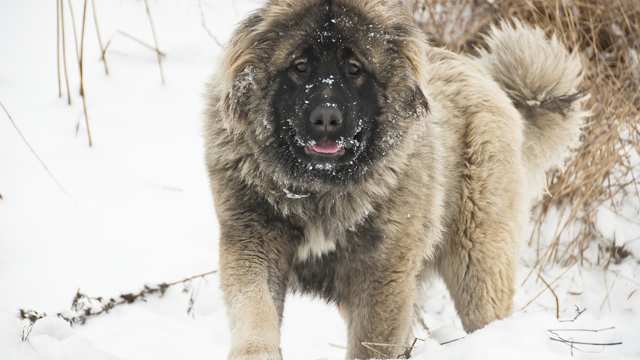
The question of whether the Caucasian Shepherd Dog is dangerous often arises due to the breed’s size, guarding reputation, and defensive behavior toward perceived threats. Evaluating danger without considering historical function and environmental context can lead to inaccurate conclusions.
This page explains how the Caucasian Shepherd Dog’s behavior relates to risk perception and why context plays a central role in understanding the breed.
The Caucasian Shepherd Dog is not inherently dangerous, but it exhibits strong defensive and territorial behavior shaped by its role as a livestock guardian. Perceived risk depends largely on environment, boundaries, and how the breed’s guarding instincts are triggered.
Understanding “Danger” in the Context of Guardian Breeds
The concept of danger in guardian breeds is often misunderstood because it is evaluated using companion-dog standards. For livestock guardians like the Caucasian Shepherd Dog, risk is linked to responsibility and boundary protection rather than unpredictable behavior or spontaneous aggression.
Danger is often defined differently for guardian breeds than for companion dogs.
Livestock guardians were developed to deter and confront threats when necessary. Behaviors that appear extreme in a companion dog context may represent functional responses within a guarding role.
Territorial Defense Versus Aggression
Territorial defense in the Caucasian Shepherd Dog is reactive to boundary violations rather than proactive hostility. Warning behaviors such as posture, blocking, and vocalization are intended to prevent escalation, but are often misinterpreted as aggression by observers unfamiliar with guardian breeds.
A key distinction lies between territorial defense and aggression.
The Caucasian Shepherd Dog primarily responds to perceived intrusions into territory rather than displaying indiscriminate or unprovoked aggression. Defensive posturing is often intended to deter rather than to escalate.
Influence of Environment on Risk Perception
Perceived risk increases in environments where boundaries are unclear or constantly changing. Dense residential settings, frequent visitors, or shared access points can amplify visible guarding behavior, even when the dog’s intent remains defensive rather than hostile.
Environmental context strongly affects how behavior is interpreted.
In open or rural environments, guarding behavior aligns with the breed’s purpose. In confined or highly populated settings, the same instincts may appear excessive or threatening due to compressed boundaries and frequent stimuli.
Role of Familiarity and Boundaries
Familiarity reduces uncertainty.
Individuals and animals recognized as part of the established environment are typically treated differently from unfamiliar presences. Clear territorial boundaries influence how and when defensive behavior is expressed.
Size and Physical Presence
The breed’s size contributes to perceptions of danger.
Large body mass and confident posture amplify the visual impact of defensive behavior, even when no physical action occurs. Presence alone often serves as a deterrent.
Situations That May Increase Perceived Risk
Situations involving unfamiliar individuals entering defined territory without gradual introduction are most likely to trigger defensive responses. This includes unexpected guests, service access, or sudden proximity in confined spaces where the dog has limited ability to create distance.
Certain conditions can intensify guarding responses.
Unpredictable environments, unclear boundaries, or frequent intrusion into perceived territory may increase alertness and defensive behavior. These factors affect perception more than inherent temperament.
Public Perception and Media Influence
Public perception of danger is often shaped by size, appearance, and selective media coverage rather than documented behavior patterns. Large guardian breeds tend to attract attention when incidents occur, even though context and management factors are frequently overlooked.
Comparison With Non-Guardian Breeds
Comparisons to companion or obedience-oriented breeds are often misleading.
Unlike breeds developed for social tolerance or responsiveness, the Caucasian Shepherd Dog prioritizes protection and environmental control, which alters how risk is expressed.
Evaluating the Breed Objectively
Objective evaluation requires contextual understanding.
Assessing danger without acknowledging working purpose, environment, and historical development oversimplifies complex behavior patterns.
Understanding whether the breed is dangerous requires viewing its behavior within the broader context of its size, temperament, and working history, which are explained in the main Caucasian Shepherd Dog overview page.