
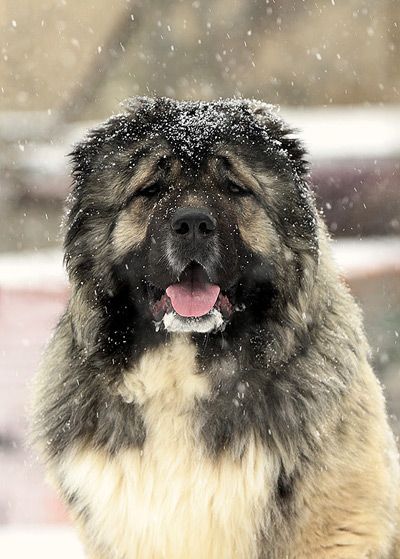
Family compatibility in the Caucasian Shepherd Dog depends less on sociability and more on structure, boundaries, and defined roles. The breed was not developed to function as a companion animal within a household, but as a protector of people, animals, and territory.
Understanding compatibility requires adjusting expectations away from affection-driven interaction and toward responsibility-based behavior.
The Caucasian Shepherd Dog can integrate into a family environment when clear boundaries, consistent structure, and realistic expectations align with its protective instincts.
Protective Orientation Toward the Family Unit
Family bonding in the Caucasian Shepherd Dog is expressed through protection rather than interaction. The breed forms attachment by assuming responsibility for household members, which explains why it may remain physically close or strategically positioned without seeking constant attention.
Protection is the foundation of the breed’s relationship with humans.
Rather than seeking attention or interaction, the Caucasian Shepherd Dog views family members as part of the group it is responsible for guarding. This often manifests as watchfulness, positioning near entry points, and heightened awareness of unfamiliar presence.
Bonding is expressed through responsibility rather than overt affection.
Relationship With Adult Family Members
The breed responds most consistently to calm, predictable adult behavior. Clear routines and stable leadership build trust more effectively than frequent commands or emotional interaction, reinforcing cooperation through structure rather than control.
The breed responds best to calm, consistent adult behavior.
Clear leadership, predictable routines, and stable environments reinforce trust. The dog does not require constant engagement but benefits from consistent presence and boundaries.
Respect is built through reliability rather than command repetition.
Children and Household Dynamics
Household dynamics change significantly in the presence of children due to unpredictable movement and noise. While the breed may adopt a protective stance toward children, supervision is essential to prevent misinterpretation of high-energy activity as a boundary event.
Interaction with children requires careful management.
While the breed may tolerate or protect children within the household, it does not naturally interpret erratic movement or loud behavior as play. Supervision and structure are essential to prevent misinterpretation of stimuli.
Compatibility improves when children understand boundaries and the dog’s role.
Sensitivity to Household Boundaries
Spatial boundaries play a central role in household compatibility. Areas such as doorways, resting spots, and yards may be interpreted as zones of responsibility, making consistent household rules critical for maintaining behavioral stability.
The Caucasian Shepherd Dog is highly sensitive to spatial boundaries.
Rooms, yards, and property lines may be interpreted as zones of responsibility. Changes in household layout or routine can temporarily increase alertness as the dog reassesses its environment.
Consistency helps stabilize behavior.
Social Expectations Versus Guardian Behavior
Families expecting constant engagement or playfulness often misjudge compatibility. The Caucasian Shepherd Dog values observation and presence over interaction, which can be mistaken for detachment despite strong protective attachment.
Families expecting constant interaction may experience mismatch.
The breed does not typically seek validation through play or attention. Periods of inactivity, distance, or observation are normal and healthy expressions of its guardian mindset.
Compatibility improves when independence is respected rather than challenged.
Impact of Environment on Family Compatibility
Environmental context strongly influences family integration. Homes with space, predictable routines, and limited external intrusion support calmer behavior, while crowded or frequently changing environments can increase vigilance within the household.
Environment strongly influences household integration.
Homes with space, predictable routines, and limited external stimulation support stability. Crowded or high-traffic environments may increase vigilance and stress.
Environmental fit often matters more than training effort.
Long-Term Household Integration
With time, familiarity strengthens predictability.
As routines stabilize and the dog gains confidence in its role, behavior becomes more consistent. Sudden changes, such as new residents or frequent guests, may temporarily elevate alertness.
Adaptation occurs through exposure, not forced socialization.
Common Misinterpretations of Family Behavior
Reserved behavior is often misread as emotional distance.
In reality, the breed expresses connection through presence and protection rather than constant interaction. Evaluating compatibility through companion-dog standards often leads to misunderstanding.
Functional interpretation leads to more accurate expectations.
Family compatibility is best understood when viewed alongside the breed’s temperament, working purpose, and environmental needs, all of which are explained in the main Caucasian Shepherd Dog overview.