
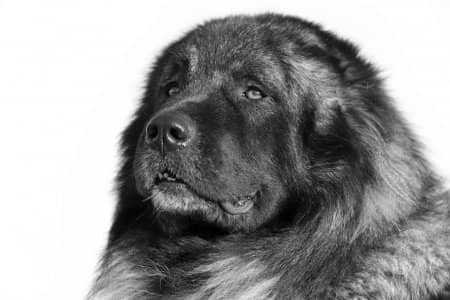
This FAQ addresses common questions about the Caucasian Shepherd Dog that frequently arise during research and evaluation. Many of these questions stem from misunderstandings about the breed’s size, guarding role, and independent behavior.
Each answer is provided in an educational context, reflecting the breed’s historical function rather than modern companion-dog assumptions.
The Caucasian Shepherd Dog is often misunderstood due to its guarding instincts, size, and independence, which leads to recurring questions about behavior, safety, and suitability.
Is the Caucasian Shepherd Dog aggressive?
The breed’s guarding behavior is often mistaken for aggression because warning signals are deliberate and visible. In most cases, posture, vocalization, and positioning are used to prevent escalation rather than initiate confrontation.
The breed is not inherently aggressive.
Its behavior is primarily defensive and territorial, meaning responses are triggered by perceived threats to people, animals, or property under its responsibility. Guarding behavior is situational rather than indiscriminate.
Is the Caucasian Shepherd Dog dangerous?
Perceived danger is closely tied to environment and expectations. In settings where boundaries are unclear or responsibility is misunderstood, guardian behavior may appear threatening even when the dog is responding defensively rather than unpredictably.
Perceived danger is closely tied to environment and management.
The breed’s size and protective instincts can appear intimidating, but risk is influenced more by context, boundaries, and human expectations than by innate aggression.
Is the Caucasian Shepherd Dog good with families?
Family compatibility depends on recognizing protection as the breed’s primary role. The dog integrates best into households that value structure, boundaries, and calm routines rather than constant interaction.
Family compatibility depends on structure.
The breed can integrate into family environments when roles, boundaries, and supervision are clear. It does not function as a highly social or attention-seeking companion but as a protector of the household unit.
Is the Caucasian Shepherd Dog good with children?
Interaction with children requires supervision.
The breed may protect children but is sensitive to unpredictable movement and noise. Structured interaction and respect for boundaries are essential for safe coexistence.
Is the Caucasian Shepherd Dog easy to train?
Training difficulty is often linked to independence rather than intelligence. The breed learns routines and boundaries effectively but does not consistently perform repetitive commands that lack situational relevance.
Training is considered difficult by conventional standards.
The breed was developed for independent decision-making rather than obedience. It learns routines and boundaries but does not respond reliably to repetitive command-based training.
Can the Caucasian Shepherd Dog live in an apartment?
Calm behavior indoors does not necessarily indicate comfort in an apartment setting. Guardian breeds may remain still while maintaining constant vigilance, which can increase mental workload in confined environments.
Apartment living is generally challenging.
Limited space, shared environments, and constant stimuli conflict with the breed’s territorial instincts. Successful adaptation is rare and requires exceptional management.
How big does the Caucasian Shepherd Dog get?
Size develops gradually and serves a functional purpose rather than visual impact. Slow maturation supports joint stability and long-term endurance, making rapid growth neither natural nor desirable. The breed is classified as large to giant.
Its size supports deterrence and stability rather than speed. Growth is slow, with full maturity reached later than in many breeds.
Does the breed need a lot of exercise?
Exercise needs are moderate.
The breed benefits from steady, purposeful movement rather than high-intensity activity. Mental workload and environmental monitoring play a significant role in energy use.
Is the Caucasian Shepherd Dog legal everywhere?
Legality varies by region.
Some areas impose restrictions or conditions based on size or guarding reputation. Ownership laws should always be verified locally.
Is the Caucasian Shepherd Dog suitable for first-time owners?
First-time owners often struggle with the breed’s independence and guarding instincts. Experience with large or guardian breeds significantly improves the ability to manage expectations, environment, and behavior.
The breed is generally not recommended for inexperienced owners.
Its independence, strength, and guarding instincts require confident handling, realistic expectations, and appropriate environment.
Why is the breed often misunderstood?
Misunderstanding usually comes from applying companion-dog standards to a livestock guardian breed. When behavior is evaluated through the lens of function rather than sociability, many perceived problems resolve into expected traits.
Misunderstanding comes from applying the wrong standards.
Evaluating the breed through a companion-dog lens ignores its working purpose. Media portrayal and lack of educational resources further contribute to misconceptions.
What is the most important thing to understand about this breed?
Purpose defines everything.
Behavior, temperament, size, and needs all trace back to the breed’s role as a livestock and territorial guardian rather than a social or obedience-driven dog.
These questions make more sense when the breed is viewed as a self-directed guardian shaped by function and environment rather than modern pet expectations. This perspective reflects the broader profile of the Caucasian Shepherd Dog where context is essential to accurate understanding.