
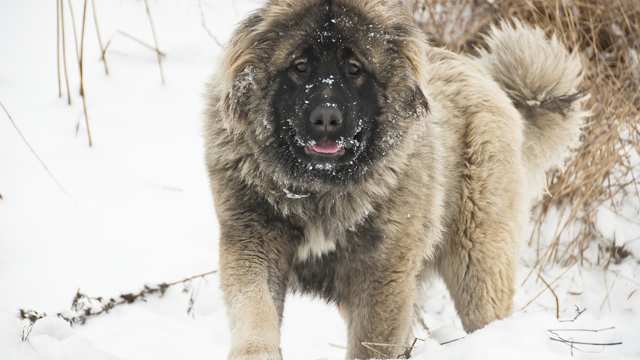
The health and lifespan of the Caucasian Shepherd Dog are closely tied to its size, growth pattern, and working background. As a large livestock guardian breed, it developed for endurance and resilience rather than longevity optimized through modern companion breeding.
Understanding health in this breed requires evaluating structural demands, environmental exposure, and functional stress over time rather than isolated conditions alone.
The Caucasian Shepherd Dog is a large guardian breed whose health and lifespan are influenced by size, slow maturation, and long-term physical demands rather than fragility or inherent weakness.
General Lifespan Expectations
Lifespan in the Caucasian Shepherd Dog is often compared to smaller breeds without accounting for body mass. Like most large guardian breeds, longevity reflects physical scale and workload rather than fragility, which explains why expectations should differ from medium or companion breeds.
The breed typically has a moderate lifespan relative to its size.
Like many large and giant breeds, longevity is influenced by body mass and structural load. While individual lifespan varies, the breed’s life expectancy reflects its physical scale and working-oriented development.
Longevity is supported more by structural balance and controlled growth than by early physical intensity.
Structural and Size-Related Health Factors
Many health considerations in this breed stem from structural load rather than genetic weakness. Joint stress, mobility changes, and endurance capacity are influenced by body mass over time, making balance and controlled growth more important than minimizing activity.
Large size places ongoing demands on the skeletal system.
Joint integrity, bone density, and overall body balance play a critical role in long-term health. Slow growth and gradual maturation help reduce excessive strain during developmental stages.
Rapid weight gain or forced growth increases long-term risk rather than improving strength.
Endurance and Functional Resilience
Functional resilience refers to the breed’s ability to tolerate environmental stress rather than resistance to disease. Long periods of outdoor exposure and vigilance shaped a dog that maintains stability under demanding conditions, which contributes positively to overall health when environment matches design.
The breed was selected for endurance rather than speed.
Functional resilience includes the ability to tolerate cold, uneven terrain, and extended periods of activity without rapid fatigue. This resilience contributes positively to overall health when environmental conditions align with the breed’s needs.
Health stability often reflects environmental suitability more than genetic fragility.
Influence of Growth Rate on Long-Term Health
Rapid growth during early development can increase long-term strain on joints and connective tissue. Allowing the breed to mature at its natural pace supports skeletal alignment and reduces stress-related complications later in life.
Growth rate has a significant impact on lifespan.
Gradual physical development supports joint alignment and muscular balance, while accelerated growth can compromise structural integrity. The breed’s naturally slow maturation is a protective characteristic rather than a limitation.
Respecting this growth pattern is critical for long-term well-being.
Environmental Impact on Health
Maintaining appropriate body condition is one of the most significant factors influencing lifespan in large breeds. Excess weight increases structural strain, while underconditioning reduces resilience, making balance more important than size reduction.
Health outcomes are closely tied to environmental suitability. Open space, predictable routines, and appropriate climate reduce chronic stress, while confined or overstimulating environments may indirectly affect physical well-being over time.
Environment plays a major role in health outcomes.
Open spaces, controlled activity, and appropriate climate conditions support physical and mental stability. Confined environments or excessive stimulation may contribute indirectly to stress-related issues rather than direct physical illness.
Health challenges often arise from environmental mismatch rather than inherent breed weakness.
Weight Management and Longevity
Maintaining appropriate body condition is essential.
Excessive weight increases strain on joints and cardiovascular systems, while insufficient mass can reduce physical resilience. Balance rather than leanness defines healthy condition in this breed.
Long-term health is supported by consistency rather than fluctuation.
Aging and Physical Changes
Aging in the Caucasian Shepherd Dog is typically gradual rather than abrupt. Reduced activity, longer recovery periods, and increased rest are normal adaptations and should be managed through comfort and mobility support rather than increased exertion.
Aging in the Caucasian Shepherd Dog is gradual.
Reduced activity, slower recovery, and increased rest are normal changes rather than signs of sudden decline. Lifelong endurance gives way to conservation of energy as the dog ages.
Monitoring mobility and comfort becomes more important than performance in later years.
Health Interpretation in Context
Evaluating health without considering size and function leads to misinterpretation.
Standards used for smaller or companion breeds do not translate directly to large livestock guardians. Health should be assessed relative to working design rather than idealized longevity metrics.
The breed’s health and lifespan are best understood as part of its overall physical structure, temperament, and working role, all of which are explained in the main Caucasian Shepherd Dog overview.