
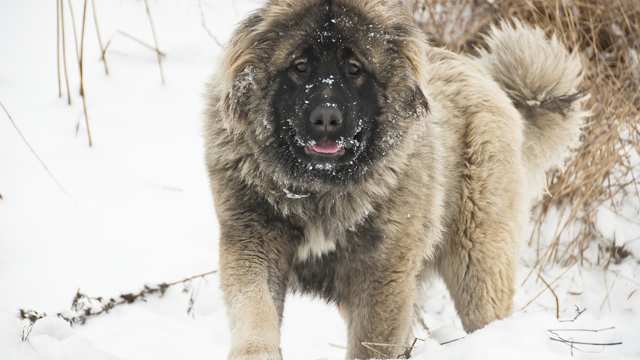
The size and weight of the Caucasian Shepherd Dog are central to its identity as a livestock guardian breed. Large body mass, strong bone structure, and imposing height were not developed for appearance, but for deterrence, endurance, and physical stability in hostile environments.
Understanding the breed’s size requires viewing it as a functional adaptation rather than a cosmetic trait.
The Caucasian Shepherd Dog is a large to giant breed whose size and weight developed to support deterrence, territorial defense, and endurance rather than speed or agility.
Functional Role of Large Size
The large size of the Caucasian Shepherd Dog developed primarily as a deterrent rather than a combat feature. Predators and intruders are often discouraged by physical presence alone, reducing the need for physical confrontation and explaining why size is central to the breed’s effectiveness as a guardian.
Large size serves a clear working purpose.
A physically imposing presence reduces the likelihood of confrontation by discouraging predators and intruders before escalation occurs. In many cases, size alone fulfills the dog’s protective role without physical engagement.
This functional deterrence explains why body mass and height were preserved across generations.
Height and Structural Proportions
Height in the Caucasian Shepherd Dog contributes to visibility and boundary control rather than speed or athletic reach. A tall, upright posture allows the dog to observe surroundings and assert presence without constant movement, which aligns with its guarding strategy.
Height contributes to visibility and dominance within territory.
A taller frame allows the dog to survey surroundings more effectively and reinforces its presence when guarding defined areas. Height is supported by a broad stance and strong skeletal structure rather than a narrow or lightweight build.
Proportions emphasize balance and stability rather than speed or flexibility.
Weight and Body Mass Distribution
Body mass in this breed is distributed to support stability and resistance rather than agility. A broad chest and strong core allow the dog to hold position when challenged, which is more important for a guardian breed than rapid directional change.
Weight in the Caucasian Shepherd Dog is distributed across a dense frame.
Mass is concentrated in the chest, shoulders, and core, supporting resistance and physical stability. This distribution differs from athletic breeds, where weight is optimized for speed and maneuverability.
Excessive leanness is not characteristic of the breed’s functional design.
Differences Between Males and Females
Size differences between males and females reflect functional sexual dimorphism rather than selective exaggeration. Males typically present greater mass and bone density, while females retain the same proportions at a lighter scale, allowing both to perform guarding roles effectively.
Sex-based size differences are pronounced.
Males typically exhibit greater height, heavier bone structure, and increased body mass. Females retain the same structural proportions at a moderately smaller scale.
These differences reflect natural sexual dimorphism rather than selective exaggeration.
Growth Rate and Maturation
Slow growth is a normal and protective characteristic of the breed. Rapid size increase during puppyhood can place unnecessary strain on joints and skeletal structure, which is why controlled growth is more important than achieving adult size quickly.
The breed matures slowly.
Growth occurs over an extended period, with skeletal and muscular development continuing well beyond early adulthood. This gradual growth supports long-term joint stability and structural integrity.
Rapid growth is neither natural nor desirable for the breed’s long-term health.
Relationship Between Size and Behavior
Large body size encourages calm, deliberate movement rather than constant activity. The breed often conserves energy and remains stationary while monitoring its environment, which can be misinterpreted as inactivity rather than purposeful vigilance.
Size influences behavioral expression.
Large body mass encourages confident, controlled movement rather than constant activity. The breed tends to conserve energy, remaining still and observant until action is necessary.
This behavioral pattern aligns with the breed’s guarding strategy of deterrence and presence.
Size Compared to Other Guardian Breeds
Among livestock guardian breeds, the Caucasian Shepherd Dog ranks among the largest.
While size varies across regions and lineages, the breed consistently maintains substantial mass and height relative to other guardians, reflecting the environmental demands of the Caucasus region.
Differences in size across guardian breeds reflect regional working requirements rather than superiority.
Modern Implications of Large Size
In modern settings, large size affects handling, space requirements, and environmental suitability more than exercise needs alone. Managing a dog of this scale requires physical control, appropriate space, and realistic expectations rather than increased activity levels.
In modern environments, large size introduces practical considerations.
Space availability, environmental fit, and physical management become more important due to body mass and strength. Challenges typically arise from environmental mismatch rather than from size itself.
Understanding size in context prevents unrealistic expectations.
The breed’s size and weight are inseparable from its historical role, temperament, and working purpose, all of which are explained in the main Caucasian Shepherd Dog overview page.