
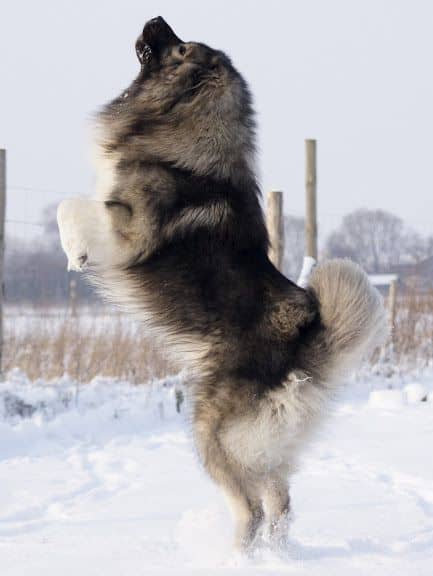
The temperament and behavior of the Caucasian Shepherd Dog are inseparable from its historical role as a livestock and territorial guardian. The breed was not developed for sociability, obedience, or constant interaction with humans, but for independent decision-making and environmental control.
Understanding this breed’s behavior requires evaluating it within the context of responsibility, territory, and threat assessment rather than companionship-driven expectations.
The Caucasian Shepherd Dog displays an independent, vigilant, and territorial temperament shaped by its role as a livestock guardian. Its behavior reflects situational awareness and protective responsibility rather than social engagement.
Independence as a Core Behavioral Trait
Independence is one of the most defining behavioral traits of the Caucasian Shepherd Dog.
Historically, the breed was expected to operate without immediate human guidance, often at significant distance from shepherds or property owners. As a result, the dog evaluates situations based on environmental cues rather than waiting for commands.
This independence is frequently misinterpreted as stubbornness, but it represents functional self-reliance rather than resistance to cooperation.
Many people describe the Caucasian Shepherd Dog as stubborn, but this behavior is better explained by its independence. The breed evaluates commands and situations based on environmental relevance rather than automatic compliance, which is typical of livestock guardian dogs developed for autonomous decision-making rather than obedience.
Territorial Awareness and Boundary Recognition
Territorial awareness is deeply ingrained in the breed’s behavior.
The Caucasian Shepherd Dog naturally establishes and monitors boundaries, treating defined areas as zones of responsibility. Movement, sound, and unfamiliar presence within these boundaries receive heightened attention.
Unlike patrol-oriented breeds that rely on constant movement, this breed often maintains strategic observation points, prioritizing visibility and control over constant activity.
Territorial behavior in the Caucasian Shepherd Dog is not random or reactive, but structured around defined boundaries. Once an area is recognized as its responsibility, the dog monitors movement and changes within that space rather than patrolling continuously.
Guarding Instincts Versus Aggression
The Caucasian Shepherd Dog is often labeled aggressive because its warning behaviors are highly visible and assertive. In reality, these behaviors function as deterrence, with the dog relying on posture, presence, and vocal signals before considering physical escalation.
Guarding behavior should not be confused with indiscriminate aggression.
The Caucasian Shepherd Dog typically responds defensively rather than offensively. Its primary objective is deterrence through presence, posture, and confidence rather than immediate physical engagement.
Escalation usually occurs only when a perceived threat persists or violates established territory, reflecting judgment-based response rather than impulsive behavior.
Behavior Toward Familiar Individuals
Behavior toward familiar people and animals differs significantly from responses to unfamiliar presence.
Individuals consistently present within the dog’s environment are generally recognized as part of the protected group. Over time, familiarity reduces uncertainty and lowers defensive intensity.
This distinction between “known” and “unknown” is a central feature of the breed’s behavioral framework.
Environmental Influence on Behavior
The environment plays a critical role in how behavior is expressed.
In open or rural settings, the breed distributes attention across a wider territory, often appearing calm and composed. In confined or high-stimulus environments, the same instincts may become more concentrated, increasing alertness and vigilance.
Behavioral challenges often result from environmental mismatch rather than temperament instability.
Behavior often intensifies in dense or unpredictable environments where boundaries are unclear. Urban noise, frequent visitors, or shared spaces can amplify vigilance, not because of anxiety, but because the dog perceives constant responsibility without resolution.
Social Interaction Expectations
The Caucasian Shepherd Dog does not seek constant social interaction.
Unlike companion breeds that thrive on engagement, this breed values observation and situational control. Periods of inactivity or distance from human interaction are normal and do not indicate emotional detachment.
Social behavior is selective and context-driven rather than universally expressive.
Reserved social behavior does not indicate lack of bonding in this breed. The Caucasian Shepherd Dog expresses attachment through proximity and protection rather than playfulness or frequent interaction, which is why it may appear distant while remaining highly engaged.
Behavioral Consistency Over Time
Behavior becomes more stable as routines and boundaries are established.
Consistency in environment, territory, and expectations reinforces predictable behavioral patterns. Sudden changes in setting or structure may temporarily increase alertness as the dog reassesses responsibility.
Long-term behavior reflects accumulated environmental experience rather than momentary stimuli.
Modern Interpretation of Temperament
Modern expectations often conflict with the breed’s original purpose.
When evaluated using standards applied to obedience-oriented or companion dogs, the Caucasian Shepherd Dog’s temperament may appear challenging. When evaluated as a guardian breed, its behavior aligns clearly with functional intent.
Understanding temperament through historical and environmental context is essential for accurate interpretation.
Final Contextual Note
Temperament and behavior are best understood as part of the complete breed profile, including history, working purpose, size, and environment, all of which are explained in the main Caucasian Shepherd Dog overview.